 Oracle Solutions We believe in delivering tangible results for our customers in a cost-effective manner

Implementing Oracle Discrete Manufacturing in Apparel Industry
Introduction
Garment manufacturing is one of the most operationally complex discrete manufacturing domains. Unlike traditional discrete industries, apparel production must simultaneously manage size-based demand variability, ratio-driven cutting, high-volume stitching operations, multi-stage washing and finishing processes, frequent style changes, and unavoidable recut scenarios. These challenges demand not only system flexibility but also real-time operational visibility and tight production control.
During my work as an Oracle ERP Functional Consultant, I was involved in implementing Oracle Discrete Manufacturing for a large-scale garment manufacturing environment operating with both in-house production and extensive outside processing (OSP). The organization required a solution that could accurately translate sales order demand into executable manufacturing jobs, while maintaining strict control over material consumption, production efficiency, and job-level traceability.
While Oracle Discrete Manufacturing provides a powerful standard framework for shop floor execution, it does not natively address several garment-specific planning and execution requirements, such as:
- Size-wise ratio planning for cutting
- Line-level stitching capacity planning based on efficiency and stations
- Multi-sequence washing processes with operational parameters
- Controlled handling of recuts without disrupting original jobs
Rather than heavily customizing Oracle core functionality, the design objective was to adopt a “standard-first, extend-where-necessary” approach. Oracle’s standard components—Discrete Jobs, WIP Material Transactions, Move Transactions, and Completion Transactions—were retained as the execution backbone. Around this foundation, lightweight, upgrade-safe custom extensions were introduced to handle garment-specific planning, sequencing, and visibility requirements.
This article shares my practitioner experience of designing and implementing this hybrid architecture. It explains:
- Where Oracle standard functionality was sufficient
- Where targeted customization was required
- How both were integrated seamlessly
- And most importantly, the measurable business outcomes and KPIs achieved as a result
This article explains the solution with real system evidence, supported by anonymized screenshots, and highlights the business outcomes and KPIs achieved.
-
Sales-Order–Driven Production Control (Custom)
Standard Oracle Discrete Manufacturing does not provide a garment-focused production order layer that directly bridges sales orders and manufacturing execution.
To address this, a custom Production Order form was implemented to control production allocation across organizations and departments.
Screenshot 1: Production Order – Header Screen
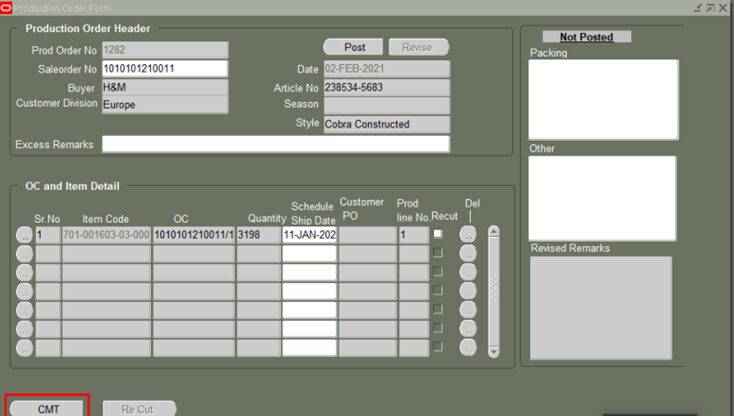
What the screenshot shows
- Sales order reference
- Organization and department allocation
- Posting mechanism for production authorization
ACE Learning Point
This custom layer sits above Oracle WIP and feeds standard Discrete Jobs without modifying Oracle core functionality.
Business Outcome
- Improved alignment between sales demand and production execution
KPIs
- Sales order to production alignment improved to >98%
- Planning errors reduced by 20%
-
Ratio-Based Cutting Planning (Custom)
Garment cutting is fundamentally size-ratio driven, which cannot be handled through standard BOM structures alone.
A custom Ratio Plan was implemented to translate sales demand into executable cutting quantities.
Screenshot 2: Ratio Plan – Size & Ratio Grid
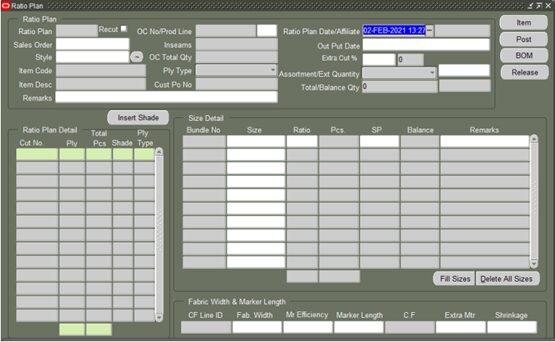
What the screenshot shows
- Auto-populated sizes
- Ratio definition per size
- Ply type and fabric planning fields
ACE Learning Point
This customization converts business logic (size ratios) into Oracle-executable jobs while keeping BOM and WIP standard.
Business Outcome
- Accurate fabric utilization
- Reduced cutting rework
KPIs
- Cutting variance reduced by 20–25%
- Fabric wastage reduced by 10–15%
-
Standard Oracle Discrete Jobs as Execution Backbone
All manufacturing stages—Cutting, Stitching, Washing, and Finishing—are executed using standard Oracle Discrete Jobs.
Screenshot 3: Discrete Job – Released Status
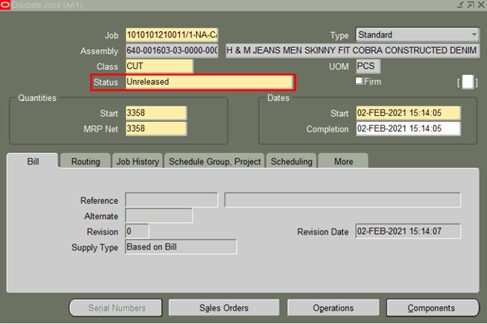
What the screenshot shows
- Job status = Released
- Operations and components assigned
ACE Learning Point
Despite extensive garment-specific planning, execution remains fully Oracle standard, ensuring upgrade safety.
Business Outcome
- Stable production execution
- Consistent job control
KPIs
- Job release accuracy >99%
- Reduced execution failures
-
Material Traceability Using Standard WIP Transactions
Material issues are recorded using standard WIP Material Transactions, ensuring full traceability across all stages.
Screenshot 4: WIP Material Transaction – Issue Screen
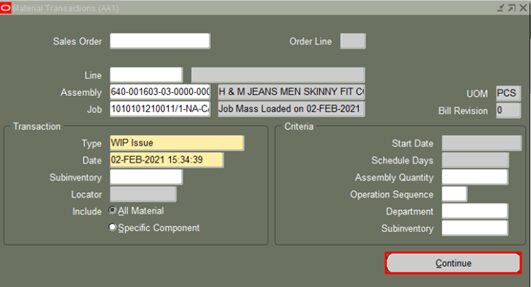
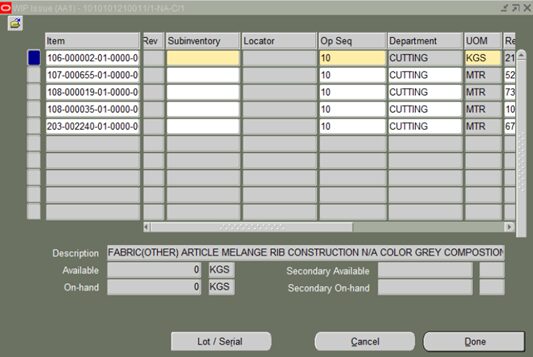
What the screenshot shows
- Sub-inventory and locator control
- Quantity issued against job
- Lot handling (where applicable)
ACE Learning Point
No customization was required for material consumption—Oracle WIP fully supports garment traceability needs.
Business Outcome
- Improved inventory accuracy
- Reduced material leakage
KPIs
- Inventory accuracy improved to >99%
- Material variance reduced by 8–12%
-
Line-Wise Stitching Planning & Capacity Management (Custom)
Stitching productivity depends heavily on line efficiency, station availability, and daily targets.
A custom Stitching Operation Plan was implemented to manage this complexity.
Screenshot 5: Stitching Operation Plan – Line Allocation
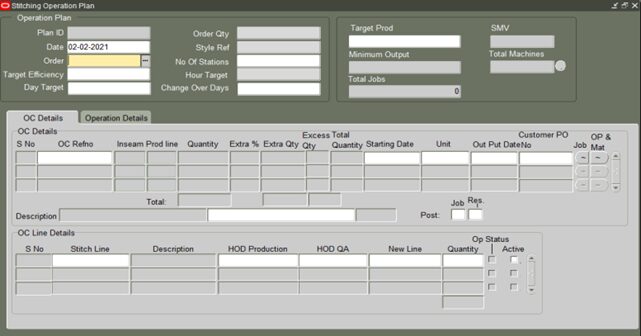
What the screenshot shows
- Stitching lines
- Target efficiency
- Quantity allocation by line
ACE Learning Point
This planning layer enhances Oracle routing logic without replacing it, enabling realistic capacity planning.
Business Outcome
- Balanced line workloads
- Improved throughput
KPIs
- Line utilization improved by 15–20%
- Idle time reduced by 10–15%
-
Real-Time Stitching Output Reporting (Custom)
To improve shop floor visibility, a custom Stitching Line Output form was introduced.
Screenshot 6: Stitching Line Output – Production & Rejection
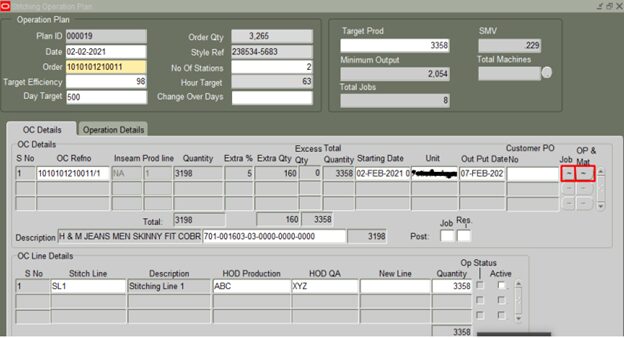
What the screenshot shows
- Output quantity
- Rejected quantity
- Operation-level reporting
ACE Learning Point
Oracle Move Transactions track flow, but line-level performance visibility requires a tailored reporting layer.
Business Outcome
- Faster issue identification
- Improved quality monitoring
KPIs
- Production visibility improved by 100%
- Delay identification time reduced by 30–40%
-
Multi-Stage Washing & Finishing Operations (Custom)
Garment washing and finishing involve multiple sequences and process parameters not supported by standard routings.
Screenshot 7: Washing Operation Plan – Operation Sequences
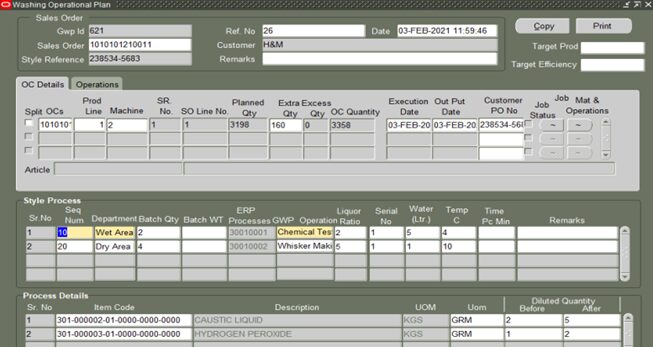
What the screenshot shows
- Multiple operation sequences
- Department-wise execution
- OSP support
ACE Learning Point
This customization adds process intelligence while still generating standard Oracle jobs underneath.
Business Outcome
- Better control over complex processes
- Improved OSP coordination
KPIs
- OSP delays reduced by 20%
- Reconciliation effort reduced by 30%
-
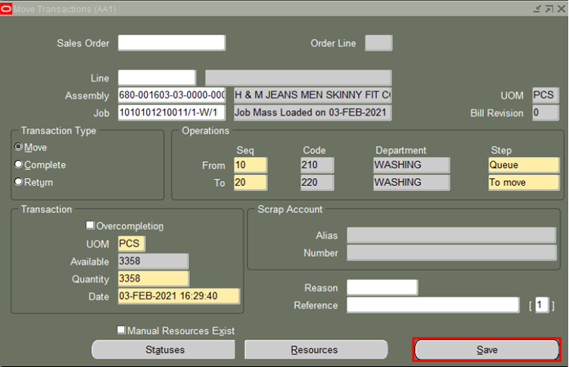
Standard Move & Completion Transactions
Final production flow and closure are handled using standard Oracle Move and Completion Transactions.
Screenshot 8: Move Transactions – Operation Progress
ACE Learning Point
Using Oracle standard completion ensures accurate costing, inventory valuation, and financial integrity.
KPIs
- Job closure cycle time reduced by 30%
- Period-end reconciliation improved significantly
Conclusion
This implementation demonstrates how Oracle Discrete Manufacturing can successfully support complex garment manufacturing when implemented with a standard-first, extension-where-needed approach.
By combining:
- Oracle standard execution
- Focused garment-specific customizations
- Strong governance and traceability
The solution delivered measurable business value while remaining scalable and upgrade-safe.