 Oracle Solutions We believe in delivering tangible results for our customers in a cost-effective manner
Oracle E-Business Suite 12.2 Next Generation Technology Stack:
A Complete Guide to Oracle’s Roadmap, Architecture and Update Process
Introduction
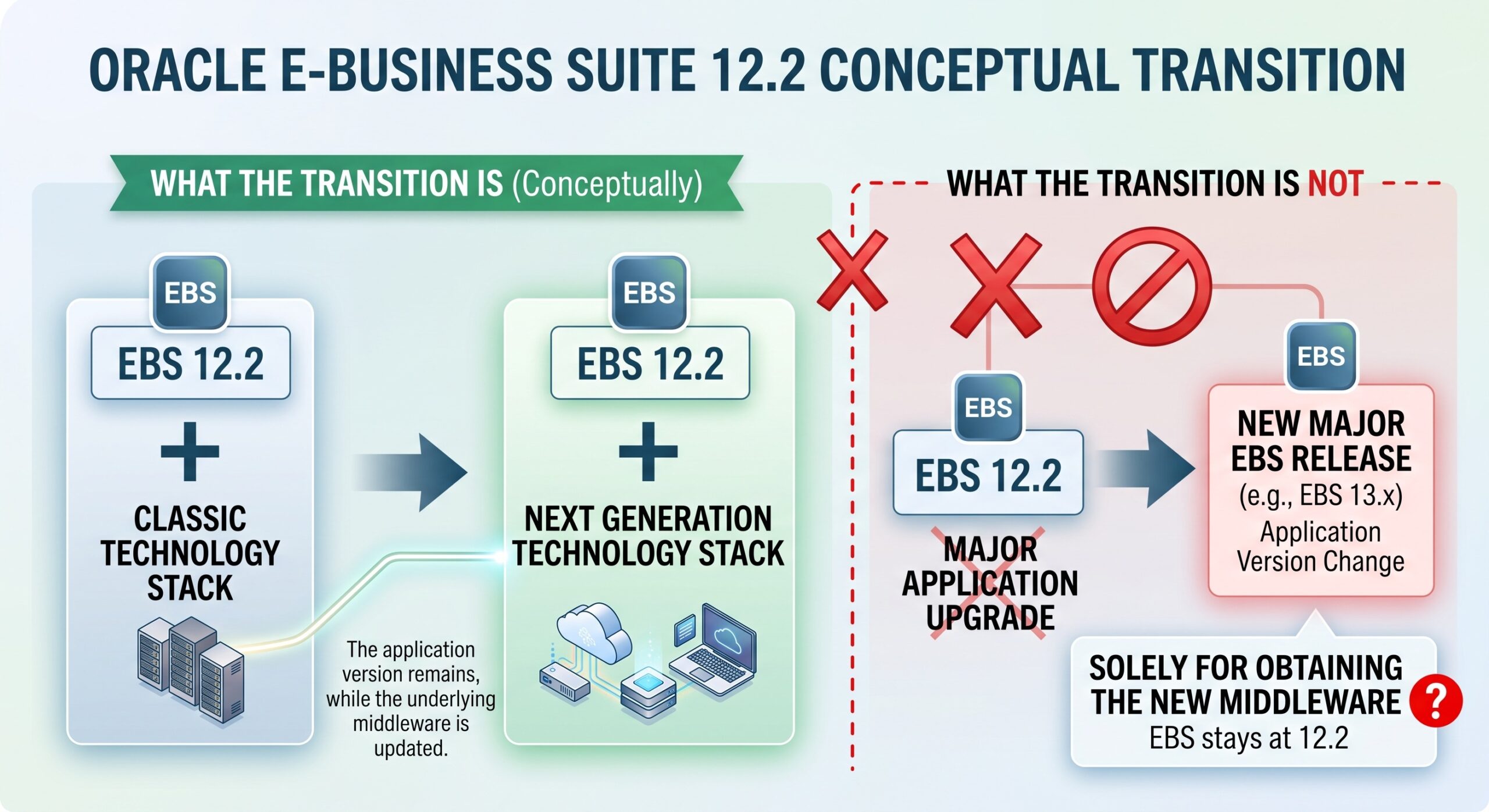
Oracle is not asking customers to move from EBS 12.2 to another major EBS release merely to obtain the new technology stack.
- Oracle Fusion Middleware 14.1.2
- Oracle WebLogic Server 14.1.2
- Oracle HTTP Server 14.1.2
- Oracle Forms and Reports 14.1.2
- Java Development Kit 17
Planned
1. What Is the Oracle E-Business Suite Application Technology Stack?
Before looking at the “Next Gen” upgrade, it helps to understand how the current version (Oracle Release 12.2) works behind the scenes.
Here is what that means in simple terms:
-
The Application Tier (The Kitchen): This is the middle engine. It sits between the user’s screen (the dining room) and the main database where information is stored (the pantry).
-
Servers & Service Groups (The Staff & Equipment): This is the team of cooks, ovens, and prep stations working together. They take requests from the user, process the business logic (cook the meal), and pull or save data from the database.
-
Facilitating Communication (The Waitstaff): It makes sure information flows smoothly back and forth between what you see on your screen and where the system keeps its files.
- Oracle Fusion Middleware: Fusion Middleware provides the middleware foundation on which several EBS application-tier technologies operate.
- Oracle WebLogic Server: WebLogic Server provides the Java application-server infrastructure used by EBS 12.2. EBS services such as OACORE and other Java-based managed servers operate within the WebLogic architecture.
- Oracle HTTP Server: Oracle HTTP Server provides the HTTP/web-tier component used by EBS. It forms an important part of the communication path between users and application services.
- Oracle Developer — Forms and Reports: A significant amount of Oracle E-Business Suite functionality continues to use Oracle Forms, while Oracle Reports is also present in EBS environments for report-generation functionality.
- Java Development Kit: Java supports several application-tier technologies and custom application components.
Therefore, when Oracle refers to an EBS Application Technology Stack update, it is referring primarily to the technologies supporting the application tier rather than replacing the EBS business application itself.
2. What Is the EBS 12.2 Classic Technology Stack?
Oracle has introduced a formal name for the existing technology foundation used by EBS 12.2: Oracle E-Business Suite Release 12.2 Classic Technology Stack It may also be referred to simply as:
- Classic Technology Stack
- Classic Tech Stack
- Classic
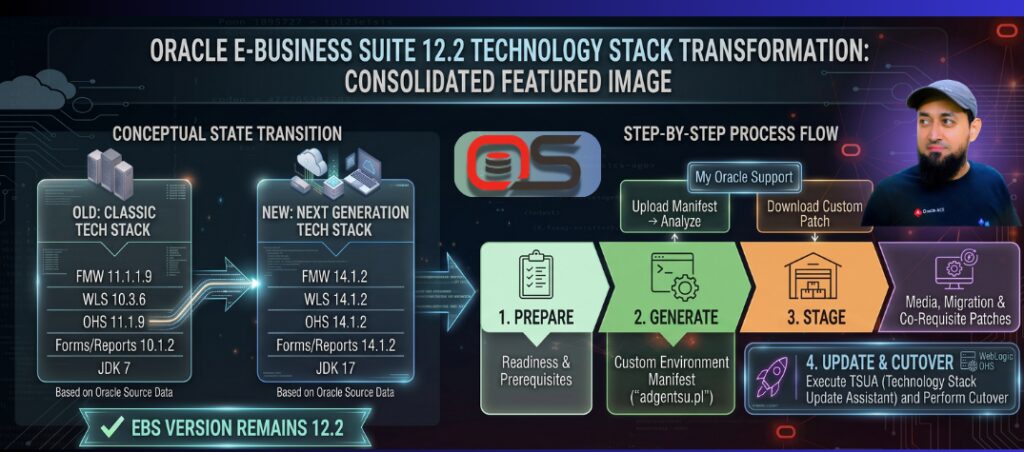
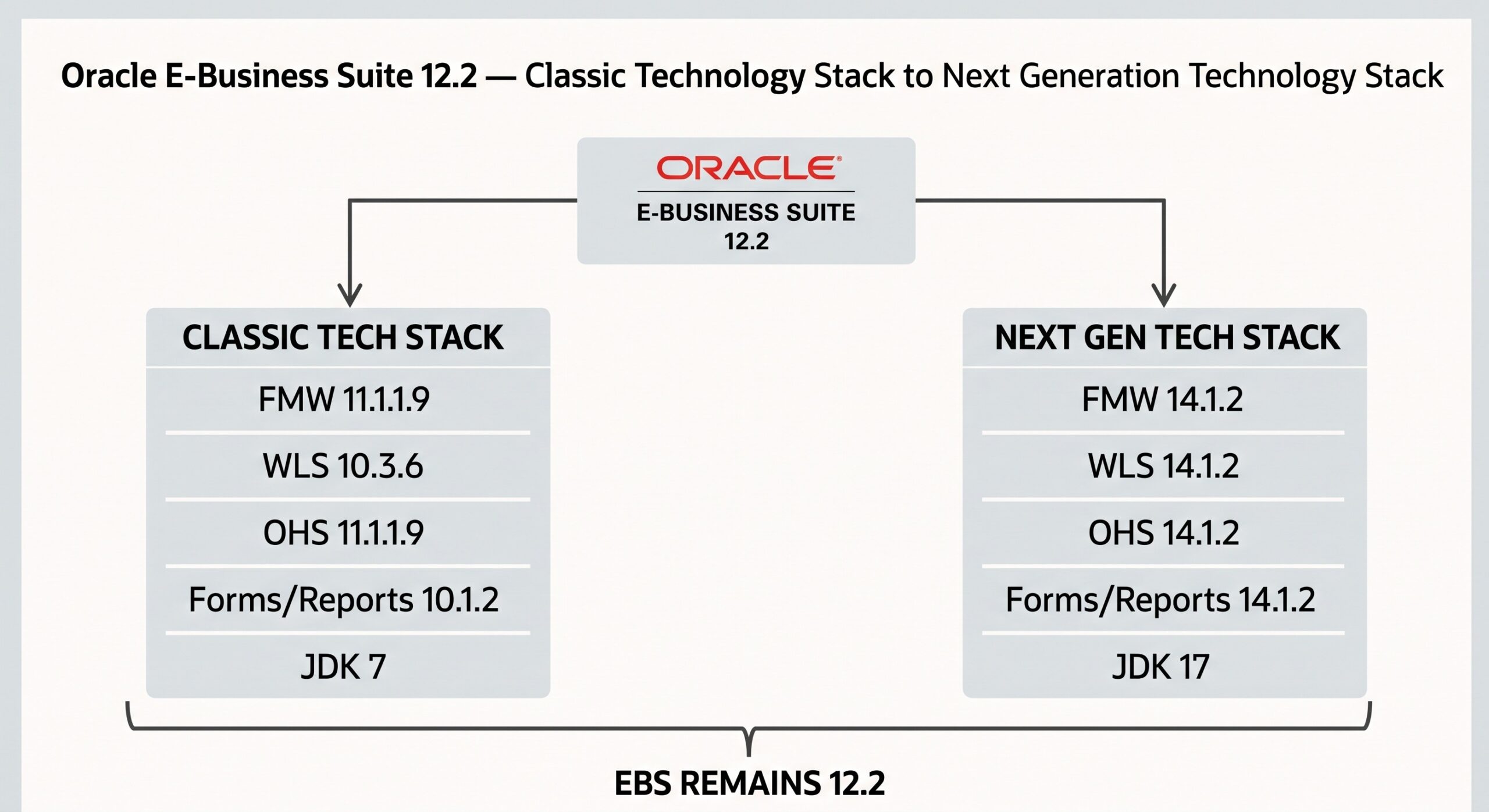
Oracle defines the Classic Technology Stack as the EBS application technology stack code levels built primarily upon Oracle Fusion Middleware 11g and Java Development Kit 7. The technology component levels documented by Oracle are:
Component |
Classic Technology Stack |
|---|---|
| Oracle Fusion Middleware | 11.1.1.9 |
| Oracle WebLogic Server | 10.3.6 |
| Oracle HTTP Server | 11.1.1.9 |
| Oracle Developer — Forms and Reports | 10.1.2 |
| Java Development Kit | 7 |
For many organizations, these technologies have supported EBS 12.2 environments for years.
Oracle’s Next Generation roadmap is designed to move EBS away from these older middleware generations while retaining EBS Release 12.2.
3. What Is the Next Generation Technology Stack?
Oracle defines the Oracle E-Business Suite Release 12.2 Next Generation Technology Stack as the planned certification of later release levels of the application technology stack components. Oracle may refer to it as:
- Next Generation Technology Stack
- Next Gen Technology Stack
- Next Gen Tech Stack
- Next Gen
Oracle’s currently published roadmap identifies the following planned component levels:
| Component | Classic Stack | Planned Next Gen Stack |
|---|---|---|
| Oracle Fusion Middleware | 11.1.1.9 | 14.1.2 |
| Oracle WebLogic Server | 10.3.6 | 14.1.2 |
| Oracle HTTP Server | 11.1.1.9 | 14.1.2 |
| Oracle Developer — Forms and Reports | 10.1.2 | 14.1.2 |
| Java Development Kit | 7 | 17 |

4. Why Is Oracle Updating the Technology Stack?
Oracle periodically certifies newer application technology-stack components to provide improvements in areas such as:
- Security
- Supportability
- Availability of newer technology features
The existing EBS 12.2 stack contains technology components from substantially older middleware generations. Modernizing the application tier allows Oracle to continue supporting the EBS 12.2 Continuous Innovation strategy while introducing later generations of the underlying technologies.
5. Does This Mean EBS 12.2 Is Being Replaced?
“No”
- Application updates
- Technology updates
- Security fixes
- Other enhancements
6. Will the Update Use Online Patching?
“Yes”
Oracle states that the update from the Classic Technology Stack to the Next Generation Technology Stack is designed to use the EBS Release 12.2 Online Patching architecture. Here is what Oracle means in simple terms:
-
No Need to Close Down (Online Patching): In the past, major background updates required shutting the system down completely for hours or days. With “Online Patching,” most of the heavy lifting and installation happens in the background while your employees are still logged in and working.
-
Why It Matters for Business: Your production system—where daily work actually happens—doesn’t have to go offline for a massive maintenance window just to get this tech upgrade.
-
The Catch (Not Zero Downtime): While people can keep working through most of the update process, it still requires a short pause at the end—like briefly closing the doors for a few minutes to flick the switch to the new setup. It significantly reduces downtime but doesn’t eliminate it entirely.
7. Will There Still Be Downtime?
“Yes”
Oracle explicitly states that a planned cutover window will still be required. This is similar to a normal EBS Online Patching cycle.
- Stopping application services
- Cutting over to the patch file system
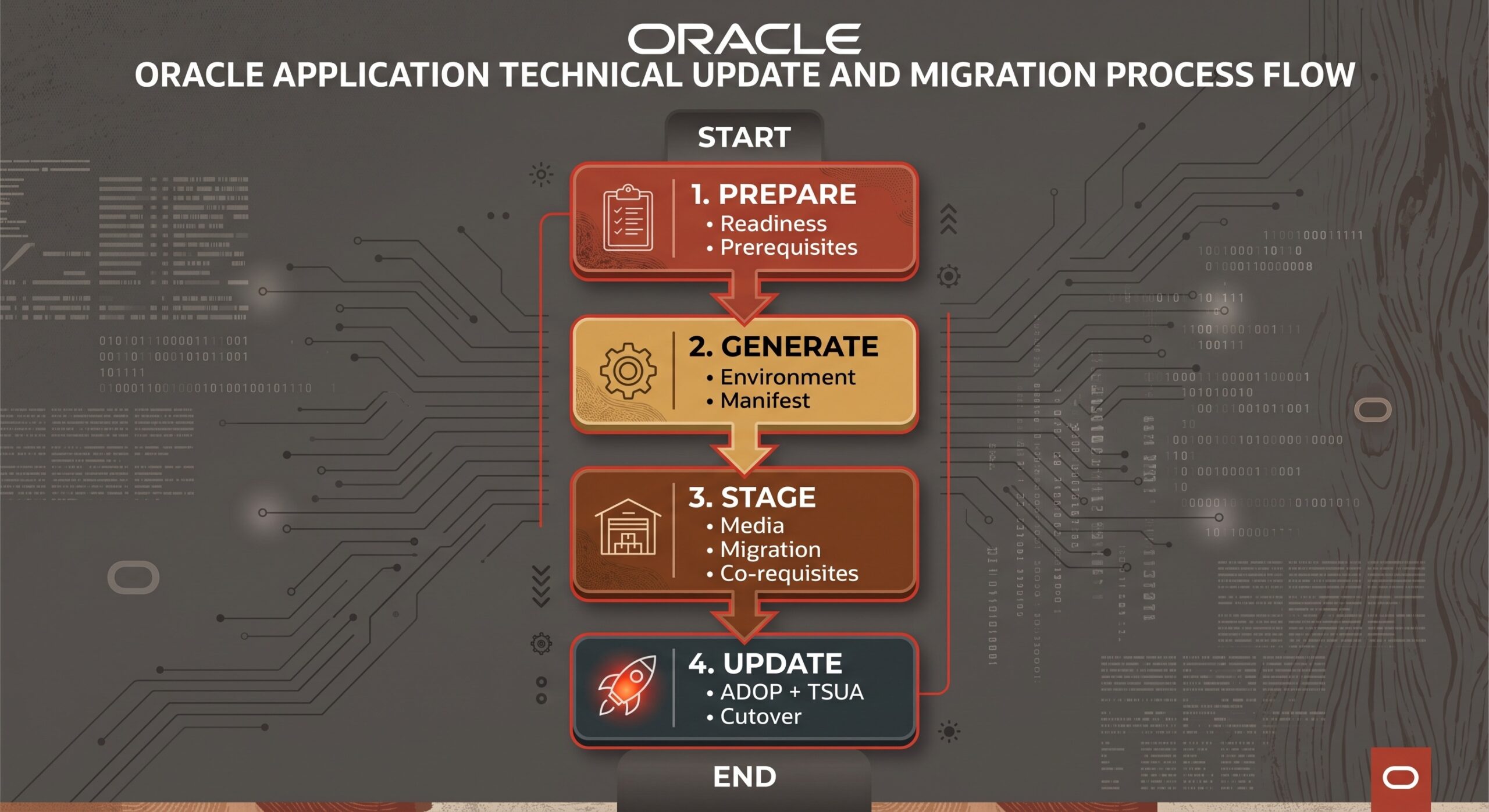
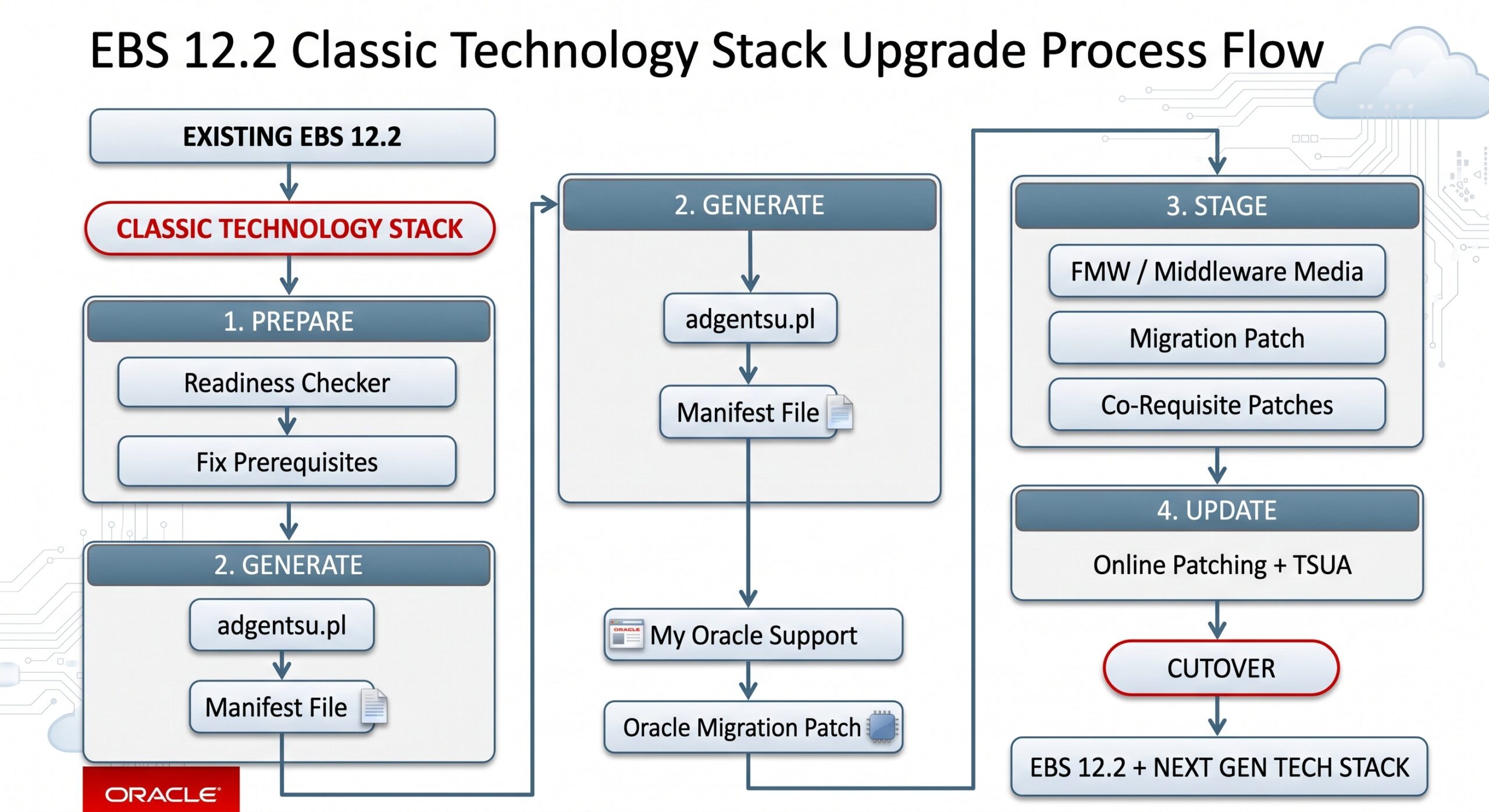
8. Oracle’s Four-Stage Next Gen Update Process
Oracle has divided the high-level update process into four stages:
1. PREPARE:
Run the Next Gen Tech Stack Readiness Checker and complete all required environmental prerequisites.
2. GENERATE
Create an environment manifest file and upload it to My Oracle Support.
3. STAGE
Prepare the stage area with the required software media and download:
- The environment-specific migration patch
- Required co-requisite patches
4. UPDATE
Update the EBS environment using:
- EBS Online Patching
- Technology Stack Update Assistant (tsua)
9. What Is the Next Gen Environment Manifest?
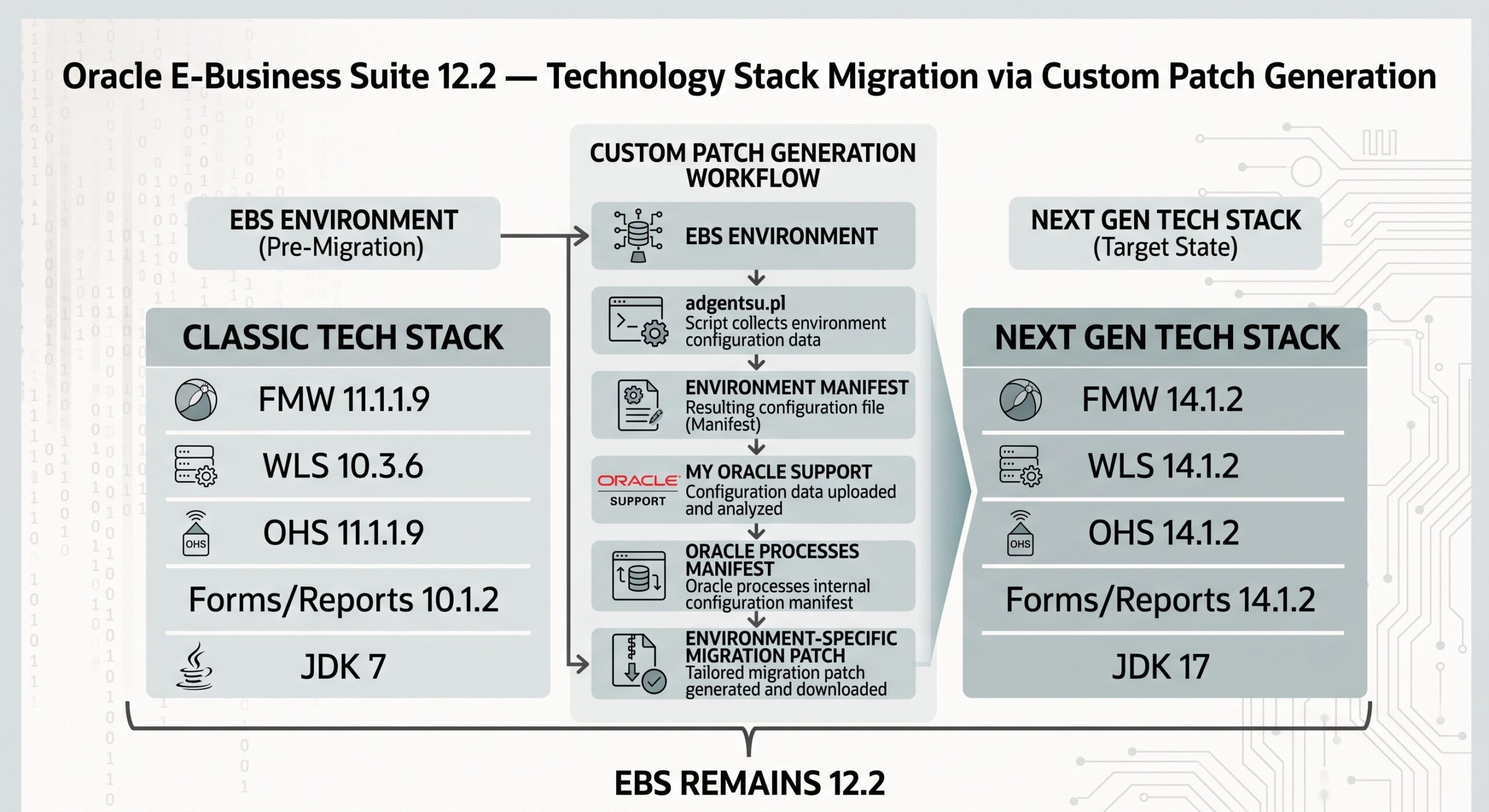
Oracle introduces another important concept: the environment manifest file. The manifest is an inventory of the EBS Release 12.2 environment that is planned for migration from Classic to Next Gen. The process is conceptually similar to the manifest used for EBS application-tier platform migration. The manifest contains information about:
- Files in the EBS environment
- Application code levels
Oracle plans to provide a new utility called:
adgentsu.pl to generate this manifest.A particularly important roadmap detail is that Oracle states this utility will be delivered with a future AD Delta release. Therefore, administrators should not expect to find the full manifest-generation mechanism in every current EBS environment today.
10. What Happens to the Manifest?
After the manifest has been generated, it will be uploaded to My Oracle Support. Oracle will use information contained in the manifest to produce a Next Generation Technology Stack Migration Patch specific to that EBS environment.
11. Why Does Oracle Need an Environment-Specific Migration Patch?
Different EBS environments can contain application files at different code levels. Oracle therefore cannot simply assume that every EBS installation contains exactly the same collection of files at exactly the same patch levels. Oracle states that the migration patch generated from the manifest will contain files that:
- Match the code levels present in the customer’s environment.
- Have been recompiled for compatibility with the updated technology stack.
This migration patch will be automatically applied as part of the process of updating from Classic to Next Gen. This is one of the most technically interesting parts of Oracle’s new approach.
12. What Is the Technology Stack Update Assistant?
Oracle is introducing another major component called the: tsua (Technology Stack Update Assistant) The Technology Stack Update Assistant is designed to orchestrate the update from the Classic Technology Stack to the Next Generation Technology Stack. Oracle states that the full TSUA capability will be introduced through a future TXK Delta release. It will operate during a special EBS Online Patching cycle.
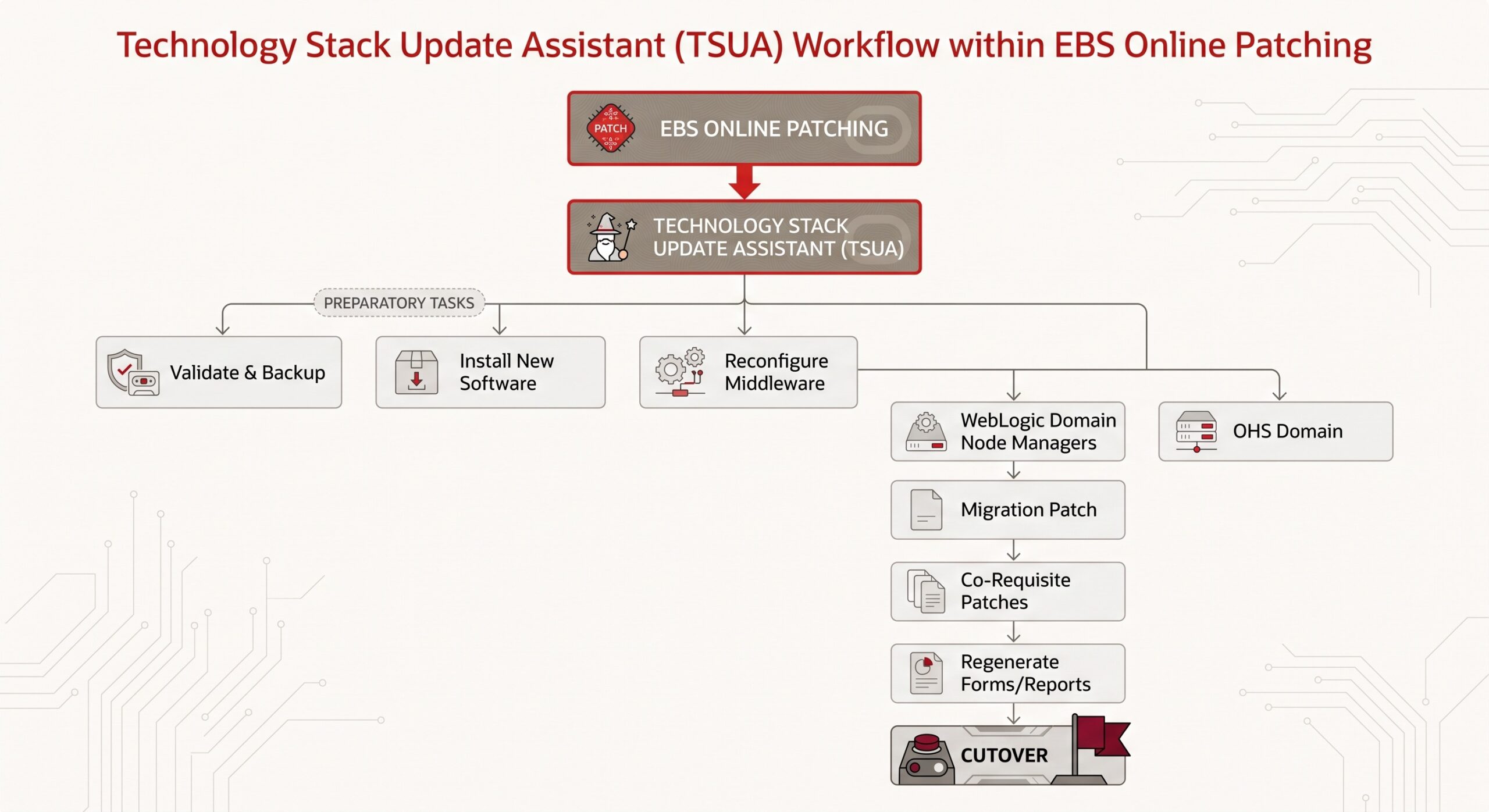
13. What Will TSUA Do?
Technology Stack Update Assistant will perform a sequence of tasks including:
Environment Validation
TSUA will validate the environment and perform required checks before proceeding with update activities.
Backup Activities
It will create required backups as part of the update workflow.
Install Software From the Stage Area
The new middleware technology will be installed using software previously prepared in the stage area.
Update Directory Structure
TSUA will make required changes to the application-tier directory structure.
Reconfigure the EBS WebLogic Server Domain
The EBS WebLogic domain will be reconfigured for the updated technology stack.
Create the Oracle HTTP Server Domain
TSUA will create/configure the OHS domain required by the updated middleware architecture.
Configure Node Managers
Required Node Manager configuration will be performed.
Apply the Migration Patch
The customer/environment-specific migration patch generated from the manifest will be applied.
Apply Co-Requisite Patches
Any required co-requisite patches will also be installed.
Regenerate Forms
Oracle Forms will be regenerated against the new technology environment.
Regenerate Reports
Oracle Reports will similarly be regenerated.
📷 Suggested Image — TSUA Update Architecture
14. TSUA Readiness vs. Full TSUA
There is an important distinction administrators should understand. Oracle has already made the Next Gen Tech Stack Readiness Checker available, and the readiness utility is executed using:
./tsua readiness
However, this does not mean that the full Classic-to-Next-Gen migration functionality of TSUA is already available. Oracle’s published an article saying that the full Technology Stack Update Assistant will be introduced through a future TXK Delta release. Therefore: ./tsua readiness is currently an assessment mechanism. It should not be interpreted as the complete technology-stack update utility already being ready for production migration.
15. Which EBS Releases Are Planned to Support Next Gen?
EBS Release 12.2.7 and later will be certified for use with the Next Generation Technology Stack. Customers running earlier 12.2 releases should therefore include an EBS Release Update Pack activity in their preparation planning.
16. What ATG_PF Code Level Is Required?
Oracle currently identifies: R12.ATG_PF.C.Delta.14or later as the required ATG_PF level for compatibility with the Next Generation Technology Stack. Customers should always verify the latest requirement from current Oracle documentation before performing the eventual update because Oracle has stated that prerequisites may evolve.
17. What About AD and TXK?
The new technology stack also requires compatible AD and TXK code levels. Future AD and TXK releases will provide the capabilities required for Next Gen. Two particularly important examples are:
| Code Line | Future Next Gen Function |
|---|---|
| AD | adgentsu.pl manifest-generation utility |
| TXK | Full Technology Stack Update Assistant |
This is another indication that customers should follow the Oracle-delivered update mechanism rather than attempting to manually replace middleware products.
18. Database Direction
Oracle’s Next Gen FAQ identifies:
- Oracle Database 19c
- Oracle AI Database 26ai
in the Next Generation Technology Stack certification direction. The current preparation/readiness document supplied by Oracle specifically checks for a sufficiently recent Oracle Database 19c Release Update. Because database certification and minimum RU requirements may continue to change, administrators should always use the latest Oracle certification information and the latest Readiness Checker before performing the actual migration.
19. A New Patch Concept: R12.TECH.B
The Next Generation Technology Stack also introduces an important change to EBS patch management. EBS 12.2 patches will have both:
- Classic Technology Stack versions
- Next Gen Technology Stack versions
Patches built specifically for Next Gen will carry the suffix R12.TECH.B These patches will be built using updated operating-system compilers and developer tools. Most importantly:
- R12.TECH.B patches can only be applied to EBS environments that have already been updated to the Next Generation Technology Stack.
- Classic Technology Stack patches will continue without this suffix during the period in which Oracle continues supporting the Classic stack.
This means future Apps DBA patching procedures will need another mandatory validation:
Which technology stack is this environment running?
before selecting the appropriate patch.
20. Is Moving to Next Gen Mandatory?
Oracle’s FAQ states that for long-term supportability, EBS Release 12.2 production environments are expected to update to the Next Generation Technology Stack. However, Oracle has also stated that the end of error-correction support for the Classic Technology Stack has not yet been determined in the supplied guidance. Oracle plans to publish an updated Classic Technology Stack support timeline after Next Gen becomes generally available. Therefore, organizations should begin preparation but should not invent an unsupported mandatory migration deadline.
21. What Should Organizations Do Right Now?
Based on Oracle’s published roadmap, organizations should begin by understanding and preparing their environments. The actual technical preparation is covered in detail in Part 2 of this series, but the high-level actions are:
- Understand the current environment.
- Run the Next Gen Tech Stack Readiness Checker.
- Identify prerequisite failures.
- Upgrade/remediate unsupported components.
- Review EBS customizations.
- Complete required preparation activities.
- Continue monitoring Oracle’s documentation for future AD/TXK releases and the complete update procedure.
22. What Customers Should Not Do?
The Oracle roadmap does not instruct customers to independently install WebLogic 14.1.2, Forms 14.1.2 or JDK 17 into an existing production EBS 12.2 environment today. Oracle is developing an EBS-controlled process involving:
- Specific AD/TXK code levels
- A generated manifest
- An Oracle-generated migration patch
- Required middleware media
- Co-requisite patches
- EBS Online Patching
- Technology Stack Update Assistant
These components are designed to work together. The correct approach is therefore to follow Oracle’s certified Next Gen procedure rather than attempting an independent middleware upgrade.
23. Putting the Entire Architecture Together
The complete concept can be summarized
Conclusion
Oracle’s Next Generation Technology Stack represents a major technology transition for Oracle E-Business Suite Release 12.2. The key message, however, is that EBS itself remains on the Release 12.2 Continuous Innovation model. Oracle is designing a mechanism to modernize the underlying application tier without requiring another major EBS upgrade solely for that purpose. The currently published roadmap targets:
- Fusion Middleware 14.1.2
- WebLogic Server 14.1.2
- Oracle HTTP Server 14.1.2
- Forms and Reports 14.1.2
- JDK 17
Oracle plans to combine EBS Online Patching with several new mechanisms: Readiness Checker → Manifest → Environment-Specific Migration Patch → Technology Stack Update Assistant This should not be treated as a simple WebLogic or Java upgrade. It is an Oracle-controlled EBS technology-stack transition with specific prerequisites, tools, patches and lifecycle stages. For Oracle Apps DBAs, the most important action today is to understand the roadmap and begin readiness work.
References
This article was prepared based on Oracle’s published E-Business Suite Technology guidance:
Disclaimer: Oracle describes several Next Gen component levels and update capabilities as planned or future items. Always verify the latest versions of Oracle’s official documentation and certification information before making changes to an EBS environment.
In Part 2, I will cover the practical side in detail: the Next Gen Tech Stack Readiness Checker, Patch 38474509, prerequisites, System Schema Migration, BI Publisher/Oracle Analytics Publisher, customization impact, Forms/Reports/Java compatibility and the steps organizations should take now.